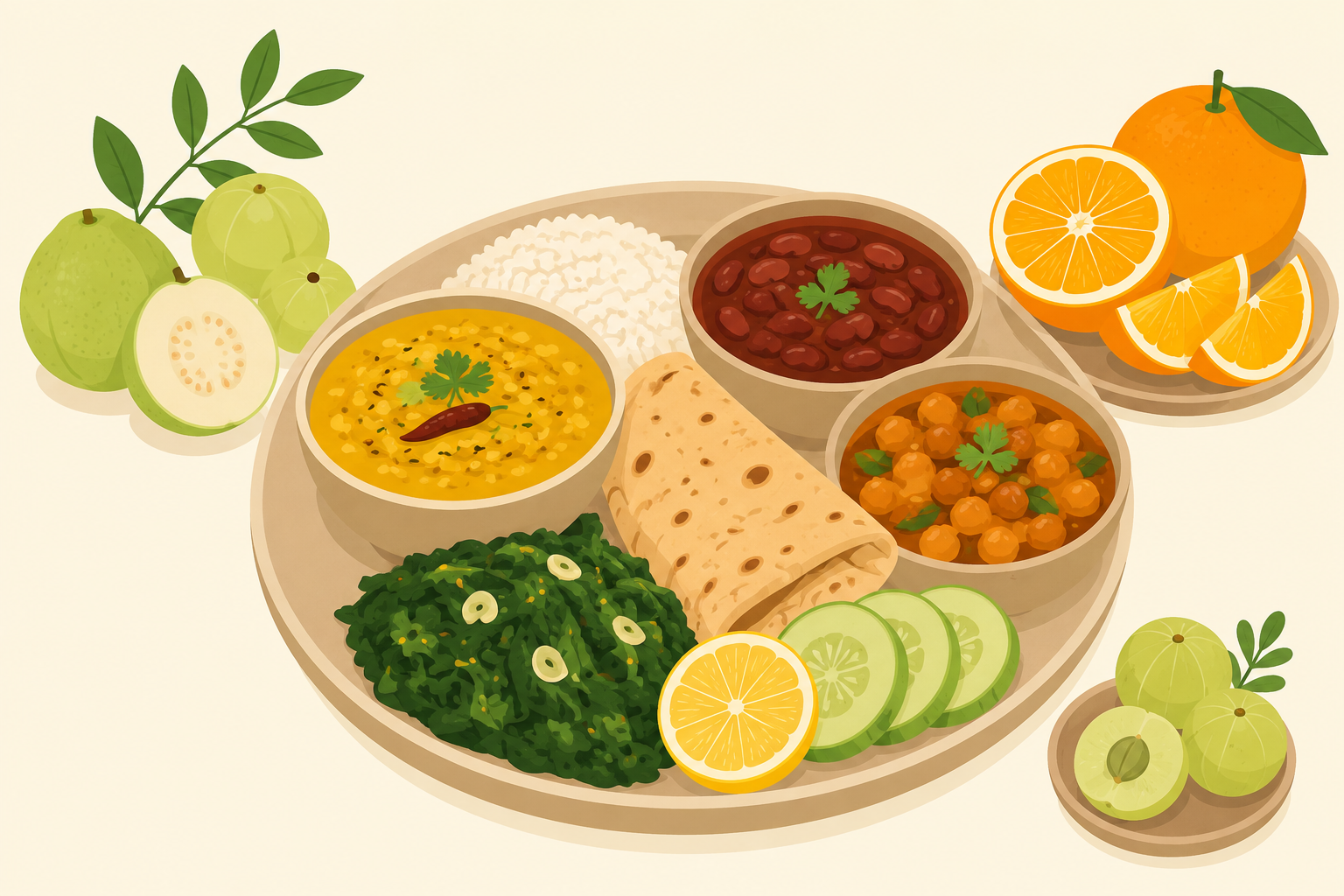
"Add vitamin C to iron-rich meals, and keep tea or coffee a little later."
If you drink tea or coffee with your meal or immediately after, it may reduce how much iron your body absorbs, especially from plant-based foods like dal, chana, rajma, and green leafy vegetables. A better habit is to keep tea or coffee at a gap from your main meal.
Add vitamin C to iron-rich meals through foods like lemon, amla, orange, or guava.
Keep tea or coffee a little away from your main meals instead of having it right away.
Pay extra attention to this if your meals are mostly plant-based and include dal, chana, rajma, or leafy greens.
This simple combination can help your body make better use of the iron already in your food.
Wellness Corner
Hidden Sugars in Everyday Foods
Many people think, “I don’t eat sweets, so my sugar intake must be low.” But sugar often comes in quietly through everyday foods that feel normal, light, or even healthy. That is why some people eat carefully and still consume more sugar than they realise.
5 surprising places sugar can hide:
Flavoured curd or fruit yogurt: plain curd and flavoured curd are not the same. The flavoured one often has added sugar.
Breakfast cereal and granola: even cereals that look healthy can contain more sugar than expected.
Packaged juice: it may feel like fruit, but it can act more like a sweet drink.
Ketchup and bottled sauces: small amounts through the day can quietly add up.
Digestive biscuits and protein bars: they sound healthier, but many still contain plenty of added sugar.
A useful habit is to ask: Is this food plain or flavoured? Plain curd, plain oats, and whole fruit are usually very different from fruit yogurt, instant oats, cereal mixes, or packaged smoothies. The flavoured version often carries the extra sugar.
Simple check: if the packet says “low fat,” “energy,” “multigrain,” or “healthy,” turn it around and check for added sugar.
Yoga Basics
The right way to breathe
by Deepansh Agrawal, Yoga Expert, Yoga Circle
In the yogic tradition, it is said that life is measured not only in years, but also in breaths. At an average of about 15 breaths per minute, we take nearly 21,600 breaths every day - more than 63 crore breaths over an 80-year life.
The message is not that we should force ourselves to breathe less. It is that the quality of something we do thousands of times each day matters. That is why learning to breathe with better awareness is such an important part of yoga.
Sit comfortably or lie down, and relax your shoulders.
Place one hand on your chest and one hand on your belly.
Breathe in slowly through the nose and let the belly rise gently like a balloon.
Breathe out slowly through the mouth and let the belly fall naturally.
After a few rounds, if comfortable, breathe in and out through the nose only.
Keep the breath smooth and easy for 1-2 minutes. If you feel dizzy or uncomfortable, pause and return to normal breathing.
Diabetes & Indian Food: Are Carbs Really the Problem?
by Madhura Paroolkar, Nutritionist, Yoga Circle
A diabetes-friendly meal is not about cutting out all carbs. What matters more is the type of carb, the portion, and what you eat it with.
What matters more than cutting all carbs
Carbs need context: Maida, biscuits, and sugary foods act quickly, while dals, vegetables, and millets work more slowly.
Portion still matters: Even a healthy food can raise blood sugar if the portion is too large. Build the plate first, then check the portion.
Fibre helps slow the meal down: It helps food work more steadily in the body, which is why vegetables and dals matter so much.
Small swaps count: Choosing makhana or khakhra over biscuits, and using sugar alternatives like stevia or monk fruit when suitable, can help over time.
Movement matters too: Muscles use glucose during activity, so safe, comfortable movement can support better blood sugar control.
The goal is not to fear carbs, but to build the plate more wisely.
This is a celebration of your discipline and consistency that you’ve poured into your practice.
Pratiksha ThakurUsha Acharya
50 Class Milestone
Celebrating the commitment, consistency, and effort it took to get here.
Radhika
Malu Manoj Kumar
Niyati
Jolly Hoonjan
Mukta Sharma
Madhu
Harsha Ladhani
Sukhvinder Kaur
Surekha Daoo
Arati Tamang
Sunita Sinha
Shraddha Sharma
Shagun
Gita Patel
Meena Wadhava
Nidhi Tulsaani
Mithlesh
Farhat
Reenu Kanwwar
Satyanarayana S
Shwetal
Vijayakrishnan
Madhav Prasad
Sanjay Patel
Nandini
Kunal Jethwani
Alka Khanderia
Kavita Manjul Adlakha
Ranjit Kaur
Shilpa
Varsha
Sushmita Roy
Jyoti Kharbanda
Rama Dogra
Farhat
Basu Pareek
Moumit Chakraborty
Sagar
Akata Kumari
Priyanka Saxena
Soorneedi Anuradha
Rizwana
Leepe
Community Voices
Chitra Ji
Subrata Sengupta
Recipe Corner
Soup of Lauki & Moong Dal
Ingredients
1 cup lauki (bottle gourd), peeled and chopped
1/4 cup moong dal, washed
1 small onion, chopped
1 small tomato, chopped
1 tsp ginger, chopped or grated
1/2 tsp cumin seeds
1/4 tsp turmeric powder
1 tsp ghee or oil
3 cups water
Salt to taste
Fresh coriander for garnish
A little lemon juice, if desired
Method
Heat ghee or oil in a pressure cooker or pot.
Add cumin seeds and ginger, then saute for a few seconds.
Add onion and tomato and cook until slightly soft.
Add lauki, moong dal, turmeric, salt, and water.
Pressure cook for 2-3 whistles, or simmer in a pot until the dal and lauki turn soft.
Let it cool slightly, then blend lightly if you want a smoother soup, or leave it as it is.
Garnish with fresh coriander and a little lemon juice before serving.
Why this is good for you
Lauki and moong dal make a light, comforting combination that is easy to digest and still nourishing. It gives the body fluids, some protein, and a gentle meal option when you want something warm without feeling too heavy.